The Linearity Trap
Last month, a prominent tech podcast came to us with $10k for a clipping campaign. We delivered 4 million views across Instagram, YouTube Shorts, and TikTok. They were thrilled. Called it a success. And wanted to spend another $10k to keep the campaign running.
Meanwhile, I’ve been watching music artists and Twitch streamers spend hundreds of thousands on clipping campaigns. Not $10k experiments. Not $20k tests. Six figures, sustained over months.
And what I’ve noticed is, when you go from 4 million views to 40 million views, the impact isn’t just 10x stronger. It’s exponentially more powerful. Maybe 30x. Maybe more.
Because attention doesn’t scale linearly. It compounds.
The Clipping Economy is Real
The shadow creator economy Blake Robbins wrote about isn’t theoretical. It’s here, it’s massive, and it’s growing faster than anyone realizes.
JasonTheWeen pays $100 per 100,000 views to an army of clippers who watch his 12-hour streams and extract viral moments. Teenagers are making $10k/month+ repurposing his content.
DoorDash posts bounties for UGC.
Offset pays creators to use his songs in TikToks.
Discord servers with 30,000+ members exist purely for bounty hunting. Streamers, musicians, and podcasters compete for the same pool of professional clippers who understand algorithmic penetration better than any marketing team.
We’re part of that world. Our network of 4,000+ clippers dissect any long-form content, test thousands of variations, and optimize for maximum views.
But we’ve discovered something the rest of the clipping economy hasn’t figured out yet.
The Compound Effect of Omnipresence
One impression is forgettable. Three impressions is interesting. Five impressions is familiar. Seven impressions is trust.
When you spend $10K on clipping, you get scattered impressions. Your content shows up in random feeds, gets a few views, and disappears.
People see you once, maybe twice. But not enough to matter.
When you spend $200-300k/month on clipping over sustained periods, something different happens. You become omnipresent.
The same person sees your founder on their For You page three times in a week. They see a clip about your product during lunch. Another one before bed. One more the next morning. You’re not just content. You’re part of the landscape. You’re familiar. You’re everywhere.
That’s when conversion compounds.
Attention Spreads Like Fire
Remember Andrew Tate’s rise? Love him or hate him, the mechanism was brilliant. He didn’t go viral because of one video. He went viral because you couldn’t escape him. Every scroll, another clip. Every feed, another absurd take. The volume created conversation, which created more content, which created more conversation.
Fire doesn’t spread one match at a time. It spreads when enough kindling catches simultaneously.
At $10k spend, you’re lighting individual matches. At $300k sustained spend, you’d create an inferno. The content escapes containment. People start talking about you in comments. Making response videos. Creating their own content about your content. You become the main character of the internet for a moment.
That’s the unlock. That’s the 30x efficiency gain (conservatively).
Tech Companies Are Missing the Obvious Play
What baffles me is that tech companies will spend $500k on a single conference booth. They’ll burn through $2M on Google Ads that convert at 1%. They’ll hire entire marketing teams to produce one whitepaper per quarter.
But spending $1M on clipping for three months, that’s somehow too experimental.
Meanwhile, every VC fund is talking about earned media and organic reach like it’s a mystical force out of control. But you can. The clipping economy proved it. You just need to operate at scale.
No tech company has fully committed yet. No VC fund has truly tested what happens when you dedicate serious budget to sustained clipping campaigns. They dip their toes with $5k, $10k experiments, see mediocre results, and conclude it doesn’t work.
Sora Changes Everything (Again)
Then OpenAI dropped Sora 2, and the entire attention economy shifted again.
Sam Altman clicked “Everyone” on his likeness permissions. Within 48 hours, thousands of AI generated Sam Altman clips flooded the internet.
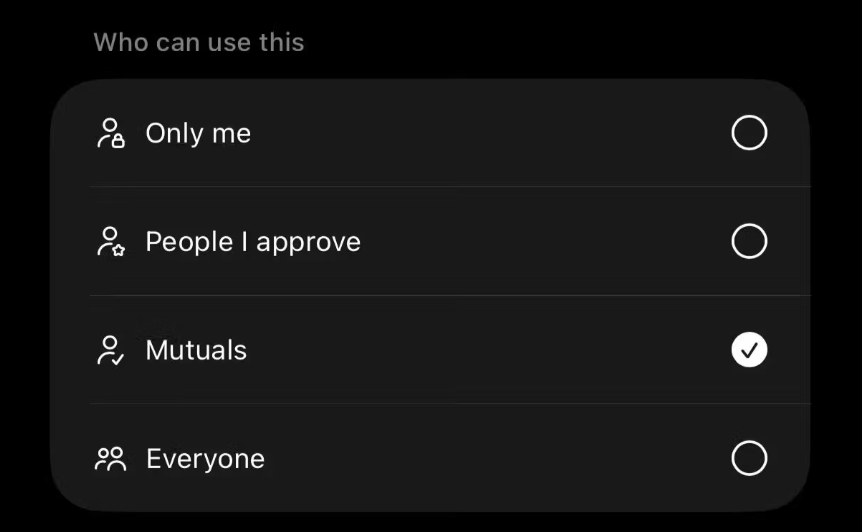
Sora 2 Cameo Likeness Permissions
Sam robbing GPUs from Best Buy. Sam pivoting OpenAI to a bakery. Sam doing the griddy in every possible location imaginable.
He achieved more organic reach in two days than most founders get in a year. For free.
This is the natural evolution of clipping. Why pay people to cut your existing content when you can let them create infinite variations using your likeness? Every person becomes a potential creator of your content. Not redistributing it. Creating it from nothing.
For brands, this changes everything. Your founder’s face becomes the platform. Your mascot becomes a template. Users don’t share your content, they instead become your content generation engine.
But, Sora 2 clipping still follows the same rules. One AI generated clip is a novelty. A hundred AI generated clips scattered across the internet is noise. A thousand coordinated clips flooding feeds simultaneously? That’s omnipresence.
Scale still matters. Maybe more than ever.
Project 100: The First Mover Advantage
We’re launching Project 100. 100 million views per month for a single client. With a targeted 30%+ US penetration. This will result in at least 7 impressions to the startup ecosystem consuming content on their phones.
To do this, we’re doing something unprecedented: dedicating our entire network of 4,000+ clippers to focus on one campaign. Not distributing them across ten clients. Not juggling priorities. One campaign. Full force. Sustained intensity.
This will be the first time a tech company commits to clipping at true scale. The first time someone treats attention like the compounding asset it actually is.
We believe this campaign will change brand marketing forever. Not because clipping is new, but because nobody has shown what happens when a tech company actually commits.
The Choice
The attention economy rewards audacity at scale. That being everywhere matters more than being perfect. That the first company to commit wins disproportionately.
Blake Robbins ended his piece by saying your face is an API. I’ll end mine differently:
Attention is a bonfire, not a candle. Stop lighting matches and wondering why nobody notices the flame.