
HydraDB Launch Post
That's what HydraDB's launch did last week. We somehow pulled it off in 5 days…
T-5: The Call
@contextkingceo booked a call with us (@atomikgrowth_) and told us he wanted to launch his $6.5M seed-funded context infrastructure startup on X. In five days. And we didn’t even know if we could pull it off with such a short timeline.
The startup had just done a rebrand and had no video or campaign assets. We needed to do everything from nothing.

The goal was to:
1/ flood the feeds of the ICP with HydraDB’s launch tweet
2/ convert existing pipeline and win new deals
3/ win X for a day and generate massive brand/product awareness
Luckily, Nishkarsh already had an idea for the video. He wanted to explain HydraDB as an analogy between a smart librarian and a dumb one. The dumb librarian grabs whatever book has a similar title. The smart librarian knows every book, including which ones are outdated, and which one you’re looking for.
That's vector databases vs HydraDB’s product.
It made the non-technical folks on the discovery call understand a technically complex infrastructure product. And we thought to use the same for announcing it to the world.
But… an analogy is not a campaign. We had 5 days, thankfully an idea, but a company most had never heard of.
Could we create something that would capture X for a day?

T-3: The Video
We had to move fast.
We ideated & finalized the video moodboard and script async over Slack, and then on a call on day 3 (after this, our next call was only the night before the launch). Our animation team started creating scenes & sequences before A-roll was ever filmed (again, cause of timeline).
Now it was time to shoot.
@contextkingceo had a tight schedule with demos booked throughout the day. So we brought the studio to him with a crew on-site at HydraDB's SF office within a 2-hour window.
Then, we created every library scene using AI (@Kling_ai, Seedream, Nanobanana). Some people DMed us asking whether it was even AI.

From a Google doc and a Figma board to a finished launch video, it took us under 72 hours. And yes, we had more than two teammates working non-stop to make the timeline.
Now we needed to figure out the influencer amplification layer in 2 days.
T-2: The Amplification Setup
A successful launch consists of several pieces of a puzzle coming together, all at once. Namely:
1/ an amazing launch asset. Can be a video (we got this covered), an article, an image thread, whatever. Just make it really good.
2/ founder community. Create a Luma event, or gcal event inviting all of your investors, friends, friends of friends, dog, cat, parrot, and whoever else you have in your network. Put your GTM team on personally messaging all of them for RSVP’s and write custom copy for the ones with larger (or, more relevant) followings to reduce their friction to amplify.
this is more important than influencer marketing.
3/ targeted influencer amplification. Use the ‘paid post’ tag to stay within X’s guidelines. We asked HydraDB for their target audience. Defined personas we had to reach. Then, we look at the following list of those folks, and see if they’re following anyone who’s within our influencer network.
Write custom copy, give them custom images/videos to post, and orchestrate what everyone sees.
We looked for accounts followed by AI engineers, devtool buyers, and infrastructure leads at companies.
And then every influencer was verified for a 33%+ US audience. For some, we had written copy about why vector search breaks at scale. For the others, we spoke about the market shift from retrieval to context.
Everything was coordinated. All that was left was launching and hoping the first 60 minutes went the way they needed to.
T-0: D-Day
The post drops.
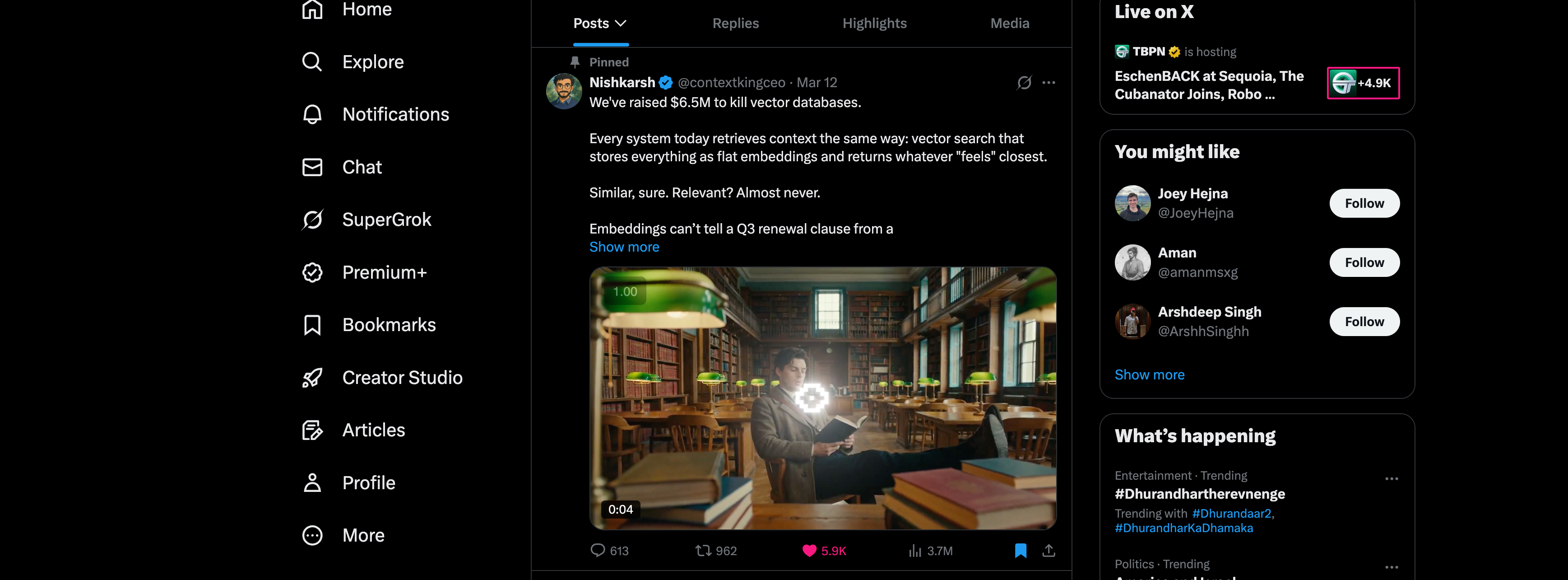
"We've raised $6.5M to kill vector databases."
The first 60 minutes make or break everything. During that window, the algorithm is measuring solely engagement velocity.
Retweets, quote tweets, replies, and likes are all relative to time.

If the ratio is high enough, the post gets pushed to a significantly larger audience. If it's not, the post dies.
We deployed our first batch of creators. The boost put the video in front of new eyes. When they interacted, the algorithm found the engagement density it required.
We really like to think of creators/influencers as ‘activation energy’. They simply help activate a post to get in front of a real, highly valuable audience. And if the post is good enough, everyone engages, and it goes viral.
And then, at around the two-hour mark, something happened.
T+2 hours: RAGE
A competitor in the AI memory space started going off.
Public callouts. Long threads. Technical objections. Tone that ranged from disagreement to outright dismissal.

Then another account piled on. Then another. Then engineers in the replies. Then people started defending HydraDB. Then more critics.
The whole thread was on fire.
Most teams would panic here as the narrative feels out of control.
We were loving it.
“We raised $6.5M to kill vector databases” is not a neutral statement. It was engineered not to be. It was written to make people react.
Every “this is wrong because…” all feeds the algorithm and builds more intrigue. It adds to engagement velocity.
The hook was made to polarise. The question now was just how far it would go.

And The Result…
2M views in under 2 hours.
Featured in X’s ‘for you’ trending for most relevant audiences.
Stayed trending for 24 hours.
3.7M total views (so far).
Hundreds of demo requests booked.
HydraDB went from no public presence to trending, Robert Scoble, Sumit Gupta interacting, and competitors publicly reacting, all inside a single business day.
What changed was the story. And how it was told.
TL;DR -
1/ the hook was a provocation, not a description.
"we raised $6.5M to kill vector databases" is a statement that demands a response. Picking the right fight, publicly, is a great distribution strategy.
2/ the video & analogy did the technical heavy lifting.
3/ the amplification was pre-planned.
the first 60 minutes of any launch are the highest-leverage window you have. Having creators, investors, and comment threads ready to fire the moment the post dropped meant the algorithm saw engagement velocity.
4/ speed. Sometimes just doing stuff fast and not overcomplicating it wins.
- Subah