Gil Feig and Shensi Ding, co-founders of Merge.
Back in May we launched Merge Gateway's Build Your Own Router for @shensi and @GilFeig at @merge_api. It's a router that sends every LLM request to the right model for your product, based on benchmarks and evals you choose yourself.
Here's roughly what the launch did:
3.67M views on the launch post
3M of those by 11:12am PT on launch day
an extra 1.09M views from 110 quote posts on top
1,316 bookmarks, almost one for every like (1,359)
all of it posted from a founder account with under 8,000 followers
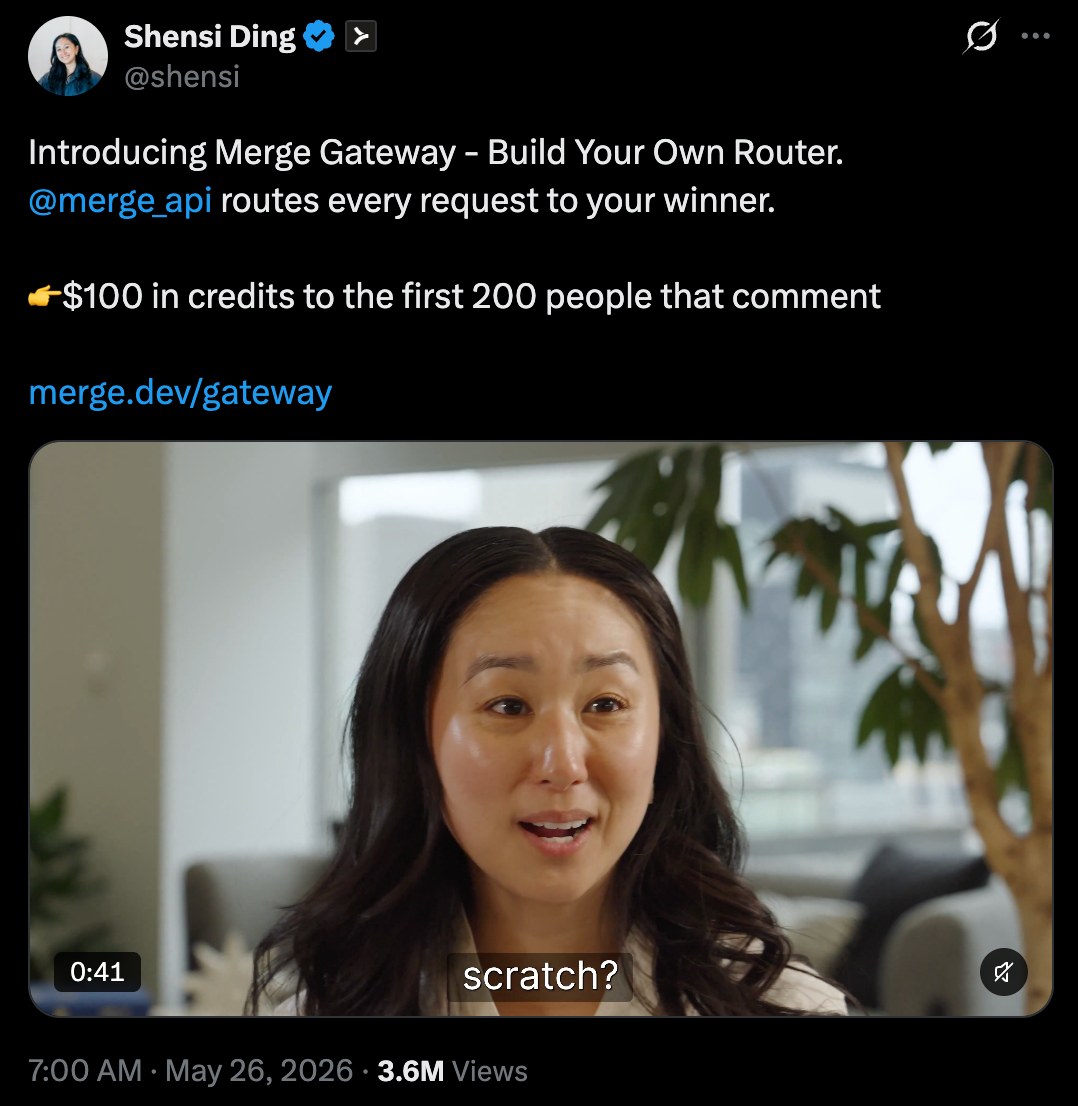
The launch post from @shensi, 7:00am PT on May 26.
Shensi's verdict, on camera: "It was one of the best days in our marketing history."
Merge isn't a small company. 750+ teams run on it, including OpenAI, Ramp and Dropbox, and it's backed by Accel and NEA. But Gateway was its first step into a brand-new category, and on X they were basically starting from zero.
Here's how we did it.
Why this one was harder than it looks
Merge is known for integrations. LLM routing is a different conversation, and @OpenRouter and LiteLLM were already the names everyone associated with it. Gateway had to break into a category where the incumbents were known and trusted.
Then there was the megaphone problem. When we asked whose account the launch should go out from, Shensi said "probably mine since i have the most followers?" Gil's reply: "shensi for sure, my shit gets no engagement." Most of the Merge team had freshly made X accounts that mostly followed each other.
And the audience was a level up from the people who'd actually use the product. In Shensi's words, "this launch video isn't really for Eng. It's for brand and CIOs / CTOs." Routing policies and eval scores are engineering vocabulary. We had to make a CTO care in two minutes.
The brief was reach, and I think that was right
Twenty-nine minutes after launch, I asked how conversion was looking. Shensi: "we got 2 signups. but idc. i just care about views."
I usually push founders the other way. I've written about launches that hit big numbers and moved nothing, and with Mave, pre-orders were the only number we cared about.
But Merge's situation was different. A well-known company stepping into a new category mostly needs the market to start associating it with that category. That means reach with CTOs, investors and the people who shape the conversation in AI infra. Signups usually trickle in from hour six onward anyway, once the post has hit people's feeds a few times and they're back at their desks.
So we built the whole launch around reach in the right rooms.
Play 1: lead with a belief
Our first script went too deep into custom routing. Merge pushed back hard, and they were right. Someone who knows what MMLU is doesn't need convincing, and everyone else tunes out.
So we pulled the story up to a belief any CTO could repeat. The launch post read:
"Your product didn't change, but the benchmark did.
That's how most AI teams operate. Chasing a 'best' defined by people who've never seen their product.
There is no best model."
By the end of the day, "there is no best model" was the most common theme in the replies. When the comment section repeats your line back to you, the positioning has landed.
Play 2: film every hook
The hook decides retention, so we didn't bet the shoot on one opener. We wrote three and filmed all of them:
1A: "A new 'best' model is released every month."
1B: "We made all major models from OpenAI, Anthropic, Gemini, and more available behind a single API."
1C: "Nobody should get to decide what 'good' means for your AI."
We also filmed alternate takes for any line still in question, so the final call could happen in the edit.
That turned out to matter. The whole project ran 18 days from kickoff to launch, and the product name changed twice along the way. We were still adjusting lines in post a few hours before launch. Shensi called it "last minute editing magic," which I'll take.
Play 3: post from the founder, then stack the signal
The launch went out from Shensi's account at 7:00am PT. Gil quoted it five minutes later with "We started seeing this pattern across every AI team we talk to." @merge_api quoted it at 7:23. Later that morning both founders went live on @MTSlive.
Shensi also gave us delegated access to her account, so we could reply, pin and steer the thread from her account while it was moving. She ended up posting 38 replies in the thread herself.
I think founder accounts beat brand accounts on X almost every time. People follow people.
Play 4: creators in tiers
44 creators quote-posted and commented at 7am. We vetted every one by who follows them. 17 of them are followed by @pmarca, for example. When a CTO sees your launch through an account they already trust, they give it an extra second.
Merge pushed back on this list at first. A lot of the accounts were investor and finance types, and they asked whether we could find more engineers. Shensi settled it: "this launch video isn't really for Eng." Investor accounts were exactly the right crowd for a brand launch.
Behind them, 150 accounts reposted from 7:15am to keep the momentum going.
Then there was Merge's own network. @MollySOShea and @TurnerNovak both quote-posted. Turner's was one of my favorites: "Wild this didn't exist before."
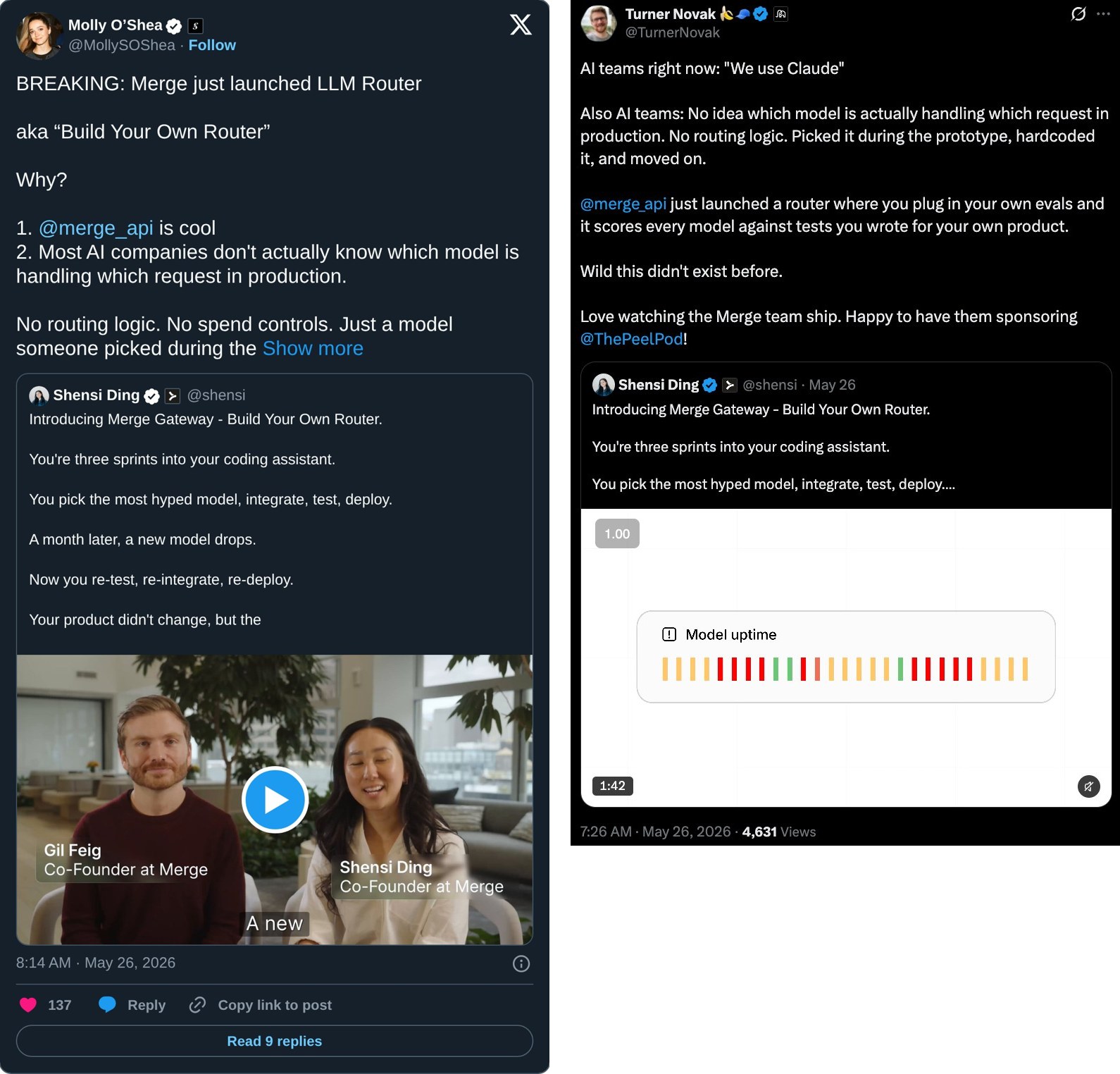
Quote posts from @MollySOShea and @TurnerNovak on launch morning.
The single biggest quote post came from @JayminSOfficial, one of the creators on our list, with 506K views on its own.
Play 5: activate your own people
Your own network does more of the work than most founders expect. Merge emailed their investors, gave employees a time to engage, and asked customers to comment in the first few hours.
Daniel on the Merge team asked a fair question here. Their employees had brand-new accounts with no X presence. Would that read as a negative signal to the algorithm? Hannaan's answer was no. It has a spillover effect, and every real person engaging early helps.
Merge also ran an offer of $100 in credits to the first 200 people who commented. To be honest, that inflates the reply count a bit, and it's worth knowing when you read the numbers. But it did exactly its job, which was to get the comment thread busy in the first hour.
Then OpenRouter raised $113M
At 7:16am, seventeen minutes after Merge went live, OpenRouter announced its $113M Series B. The best-known name in LLM routing, in the same feed, in the same hour.
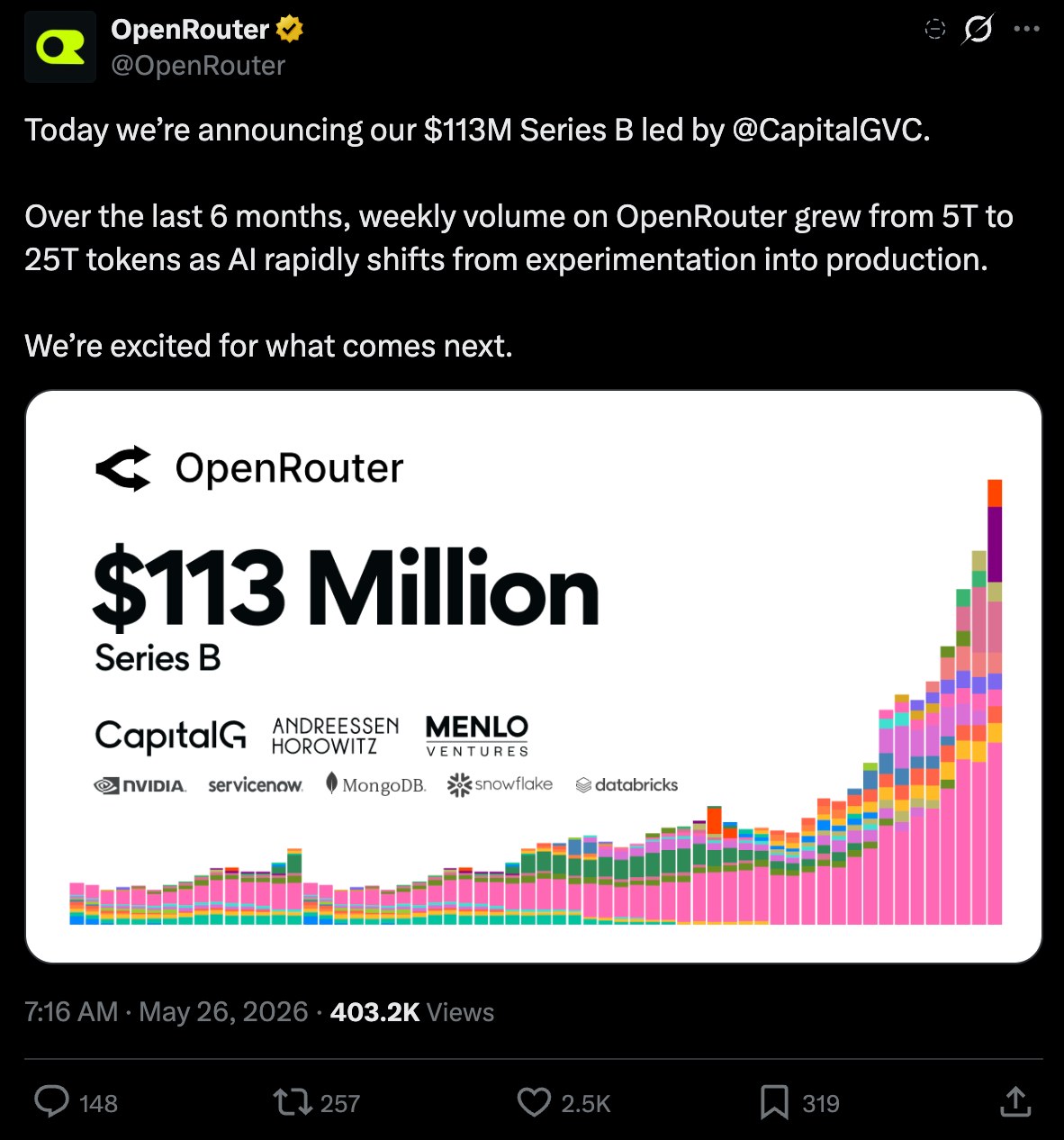
OpenRouter's Series B announcement, 7:16am PT the same morning.
You can't plan for that. You just have to be awake when it happens.
By 9:32am we were stalling at 2M. So we went to work:
we asked creators to use #merge and tag Shensi in their comments, to push the launch into Today's News for the AI crowd
we had influencers engage with the big replies from @packyM and @TurnerNovak, so those threads carried the launch further
Gil reposted Shensi's post tagging MTS ahead of the founders' live slot, which kept the impressions on the original post
we sent the Merge team a list of the best comments to like, so the thread looked good to everyone arriving late
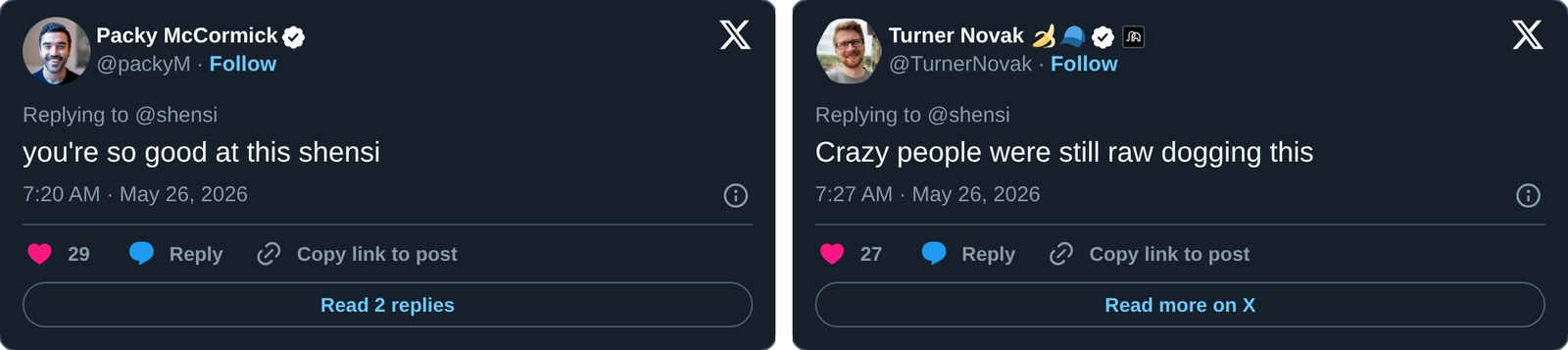
Two of the replies we pushed further during the stall.
By 11:12am it was at 3M. By 9:38pm, 3.3M. It kept climbing to 3.67M.
One honest note. Retention was on the lower end because the video ran almost two minutes, longer than most launch videos we make. Looking back, I'd probably cut it tighter.
What it actually did
3.67M views on the launch post, about 467x Shensi's follower count
1.09M more views from 110 quote posts
1,316 bookmarks against 1,359 likes, so people were saving it to come back to
replies from @packyM ("you're so good at this shensi"), @ChrisJBakke ("Have always been a big Merge fan but this make me love the product even more"), @ClementDelangue, @kimmonismus ("The routing layer problem is massively underrated"), Molly ("LLM Routers are so hot rn") and @bdistel, whose team at Windmill already runs on it ("We've been using this @trywindmill! Awesome product.")
overwhelmingly positive sentiment, with the skeptics mostly comparing it to OpenRouter and LiteLLM
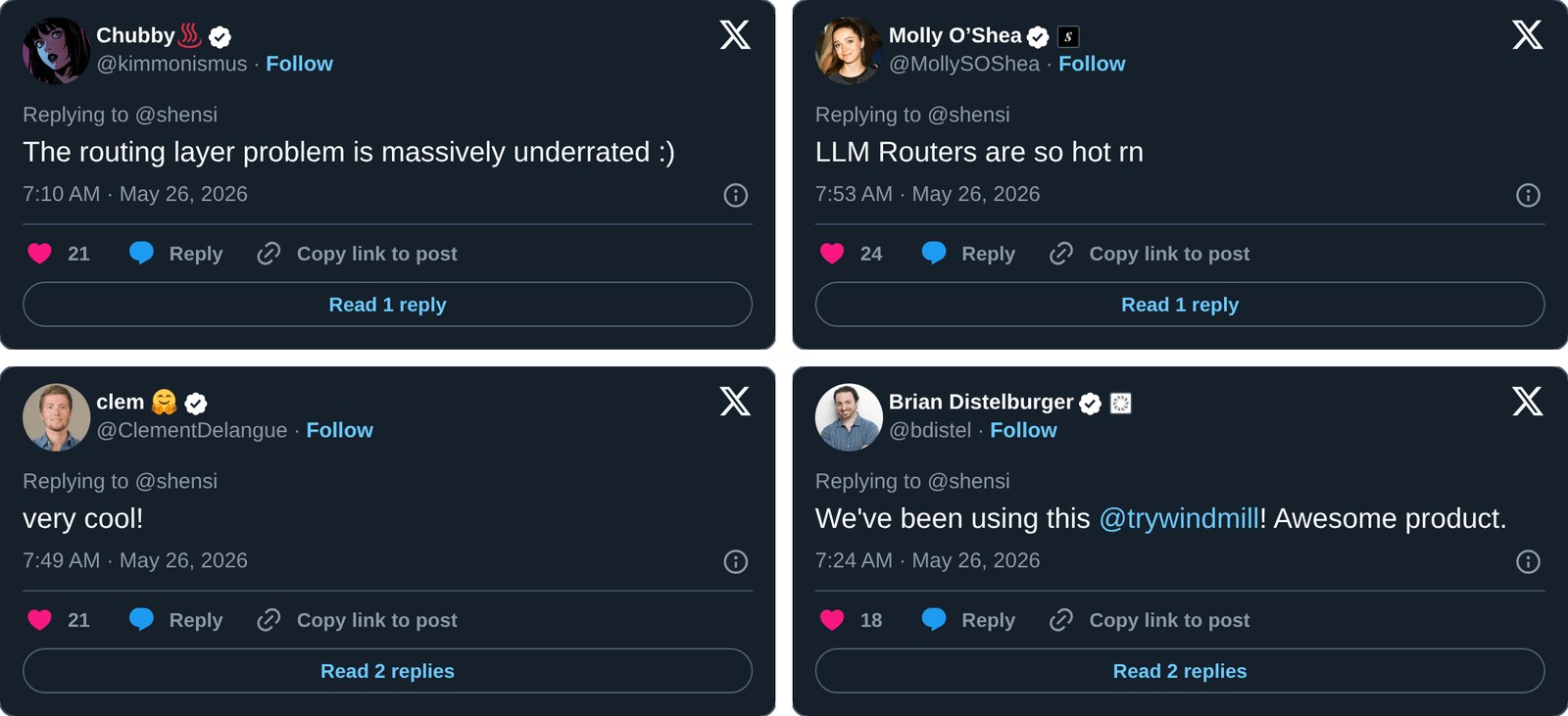
A few more replies from launch morning.
Two days later, Merge asked if they could put paid promotion behind the video on X and LinkedIn. That told me more than any number.
You can hear Shensi talk about the whole thing here: https://youtu.be/J2LKOE72R8Y
Watch Shensi on the launch: youtu.be/J2LKOE72R8Y
The takeaway
If you want the short version:
Know what the launch is for. Reach and conversion need different launches.
Lead with a belief your buyer can repeat.
Film more than one hook and decide in the edit.
Post from the founder and stack the co-founder and company quotes behind it.
Vet creators by who follows them, and pick the audience the launch is actually for.
Get your own people engaging in the first hour.
Stay awake through the whole day, because something will happen you didn't plan for.
This is what we do at launchvideo.com
- Subah